
This is very simple. The best shutters for bathrooms and kitchens that are not only durable and long-lasting but have a beautiful appearance are foamed synthetic shutters such as Duracore Shutters™. They are water-resistant, easy-to-clean, and will withstand the moisture conditions of a kitchen or bathroom, while looking like a top-quality wood shutter.
Author: ss-admin
How To Find The Best Deal On Shutters
As a homeowner, you can definitely find high quality shutters at a reasonable price. Your best bet is to gather a little product knowledge so that you know which shutter you will be happiest with-that way you will get the best deal available for your shutters. The fact is that there are many different kinds of shutters available to you, but some are definitely better than others. Because shutters tend to be more expensive than other window coverings, you will want to make the right choice-an informed choice-before meeting with a salesperson.
By taking a few minutes to make a truly informed choice, you can save money and enjoy the finest shutters on the market. A fine shutter should last virtually as long as a home does, requiring only minimal maintenance and cleaning, and provide all of the beauty and ease of use that you’re looking for. It should hold its value and come with a transferable warranty. Make sure that the warranty for your shutters is either lifetime for synthetic or at least 25 years for wood, and that the shutter warranty includes service and covers construction, installation, moving parts, and the painted or stained finish. Taking these things into consideration should enable you to find a great shutter deal.
Shutters are either made of wood or synthetic material. Wood shutters tend to be more expensive and there are many different kinds of wood available-basswood, incense cedar, alder, poplar, engineered wood, and so on. For most homes, basswood is the preferred wood. It is a stable, light hardwood that holds a beautiful finish well. And because basswood shutters are less expensive than most other wood shutters, it is not only the preferred wood but also a great value. Depending upon the vendor, a homeowner should be able to find great basswood shutters on sale for a dollar price ranging from the mid-$20’s to the mid-$60’s per square foot, more if they are stained rather than painted.
Synthetic shutters basically come in three grades: hollow plastic, composite, and foamed synthetic. Although hollow plastic shutters (called plastic, vinyl, etc.) may be found at really low prices-even $18 per square foot-they look plasticky and will soon usually wear and tear, discoloration, and broken parts within a few years. We advise homeowners to avoid such products. Composite grade shutters usually combine a kind of wood strip or particle board such as MDF with a painted or plastic-coated finish. They often have a fine appearance at first but are also vulnerable to wear and tear and weathering. For the same or slightly higher price point than medium-grade composite shutters, you can purchase foamed synthetic shutters, which are the premium synthetic shutter available today. The best foamed synthetic shutters are reinforced with an inner aluminum frame for greater stability. They are not only beautiful but are the most durable shutters out there. And they are very energy efficient and often certified green building materials. You can get a great deal on foamed synthetic shutters, with a square foot price ranging from the mid-$20’s to the mid-$60’s. At The Shutter Source, we offer a superb foamed synthetic shutter, Duracore Shutters™, which we feel is the finest shutter on the market today.
You can read more about the different kinds of shutters available on A Consumer’s Guide to Shutter Construction and Material, featured on our website, or call us at 1-877-333-9424!
How Do I Clean Shutters?
One of the best things about your shutters is that they are so easy to clean!
Wood shutters should be dusted with a microfiber dusting cloth, preferably and most easily from the reverse side. For major cleaning, a slightly damp cloth and handwashing liquid is safe. Make sure that the shutter is left completely dry when you’re finished with its cleaning! If you prefer to use furniture polish, make sure that it is clearly marked “non-yellowing.” All polishes may affect the ability to refinish a shutter in the future, so be careful, and avoid solvents or abrasive cleaners.
Some synthetic shutters, including foamed synthetics such as Duracore Shutters™, are waterproof and may be safely cleaned with a slightly damp cloth, maybe with a little dish soap if necessary. Since shutters like Duracore Shutters™ are dust-resistant, most of the time they will only require dusting with a soft material.
Never take shutters into your backyard for a spray down, especially wood shutters!
If a professional housecleaner cleans your home, make sure they’re briefed on these handy tips for cleaning shutters.
Remember that shutters are very easy to clean so long as you follow these helpful tips!
How Long Have You Been In The Shutter Business?
Irv, How long have you been in the shutter business?
I’ve been working in the shutter industry right from the start. The modern shutter industry was in its infancy when I was a teenager. I needed a summer job and started working in the production department at Paul Heinley Shutters, building shutters, and have had my finger on the pulse of the industry ever since.
There really was no shutter industry before Paul Heinley. Paul and his wife discovered the beauty of shutters while visiting New Orleans in 1943. She fell in love with their beauty and functionality. Paul was a design engineer for Hughes Aircraft whose hobby was wood-working. He made some shutters for his wife for her birthday, started building shutters for friends and within a few years was famous nationwide. When I joined his company, its reputation for strict adherence to quality and design made it the leading shutter company of its day and helped inspire the popularity of shutters today. Learning the shutter business at Heinley was challenging yet fun. I loved the machinery and the creative process of building something. I loved the smell of the factory and the challenge of meeting their perfectionist standards.
After mastering the art of shutters, I started my own shutter company. I’ve always enjoyed working with a wide variety of people, helping customers find solutions for their home, and enjoyed the creative process of design and manufacturing.
How was the shutter industry different then?
In the early days of the shutter industry, the material of choice was Sugar Pine. There were no synthetic shutters. The overall quality in the industry was much higher in those days, quality now ranges from excellent to poor, depending upon the product a homeowner selects. Prices were two to three times higher then, adjusted for inflation! That’s why, at The Shutter Source, I emphasize “the best shutters at the best price.”
What is the most beautiful shutter installation that you participated in?
I’ve done over 14,000 jobs to date in my career, many of them strikingly beautiful. We just finished a job north of Sacramento in an A-frame mountain home. You can see photos of it on our website. It is beautiful and spectacular. A while back we did an onion-dome shaped shutter installation that was pretty striking. And we once built a 23 foot tall shutter installation as a room divider and a 70 foot wide glass wall, on a single overhead track. This creative solution allowed a developer to get $30,000 more for his units.
What is important to you in delivering customer service?
We work hard to ensure that our customers are happy with their shutters, to exceed their expectations when we deliver and install their shutters. There are times when that can be a challenge. It makes me happy to see the smiles on customers’ faces when their shutters are installed in their home.
Irv, why should homeowners choose The Shutter Source?
I believe that we offer the ability to accomplish almost anything in our business from the exquisite small job that puts the finishing touch in a library or the hotel that wanted us to install 500 windows in four days. We can do these things with grace, competence, and style.
Although known for our mastery of fine wood shutters, our most popular product is Duracore Shutters™. I believe that the Duracore Shutters™ are absolutely the finest on the market today. It is not only beautiful but stays beautiful for many, many years, probably lasting as long as the home. It is the most durable and long-lasting shutter on the market. Duracore Shutters™ are water-proof, dust resistant, scratch resistant, energy efficient, Green-certified, and come with a lifetime transferable warranty. We offer it at a very low price.
We are a relatively small company and try our hardest to deliver a wonderful product that is installed to our standards, which in most cases is higher than our customer’s expectations. We do this at a terrific value with a smile. We are very versatile and our people are the best of the best. I love it when we exceed customers’ expectations and invite customers to call me personally about their experience once we install their shutters in their home. After more than forty years in the shutter business, the beauty and functionality of the shutters and the smiles on customers’ faces are still what inspires me.
A Spectacular Shutter Installation
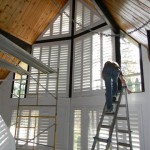
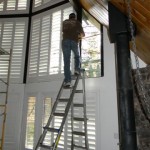
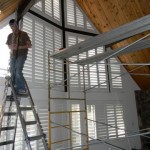
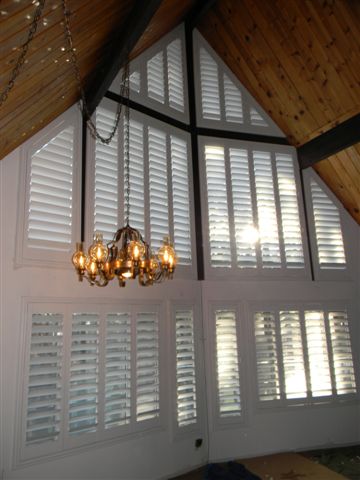
This month we take a look at two big shutter topics. The first topic regards how to design and install shutters for difficult and unusual structures. The second is the importance of excellent shutter installers. Many homeowners have unusual windows and are puzzled about how to cover them, especially arched and slanted windows. And because shutters are relatively difficult to install compared to other window treatments, homeowners should demand highly skilled professional shutter installers. Our installation supervisor, Kevin Warren, recently installed an impressive array of shutters for slanted windows, and his experience demonstrates the right way to approach each of these topics. Here is my dialogue with Kevin.
Richard: Kevin, you produced a truly spectacular installation. The photos are quite dramatic and show that installing those shutters must have been challenging. Tell us the homeowner’s goal in shuttering that entire side of the A-frame home.
Kevin: As you can see, the home is an A-frame in the mountains. There is plenty of glass looking out onto the forest. The homeowners wanted to control heat and light while keeping the view intact and preserving the beauty of their home. They had no idea of how to accomplish their objective through window treatments. Eventually, they realized that only shutters would provide what they wanted for their home.
Richard: The reason the customers wanted that array done on that A frame-light control, privacy, how did shutters solve their problem?
Kevin: The first desire of the homeowners was to control light and heat. Although the big array of windows on that side of their home provided a spectacular view of the trees, it wasn’t energy efficient and the continual impact of sun during daylight hours threatened to fade their floors, furniture, and artwork. The shutters were designed with large louvers that, when fully opened, allowed that beautiful view to flow into the home. But when the louvers were partially closed in either direction, the house cooled down and the interior was protected from fading. When the louvers are fully closed, there is a near blackout and plenty of energy efficient insulation, totaling removing the impact of the sun and, of course, providing privacy.
Richard: How is special care taken with rake tops in designing and measuring?
Kevin: Special care is taken on every opening, door or window, every day. The key to a perfect shutter installation happens when the installer does his precision remeasurement. When I arrive in the home to precisely remeasure the windows for shutters, I visualize the finished product, I can prevent any problems in advance. Every home is different and the factory cannot see what the installer has seen with his own eyes. As an installer, this skill takes years of experience to develop. I am the eyes of the factory and I must get it right the first time. At The Shutter Source, we take great joy in having the lowest error rate in the industry, due to our experienced installation crew. Our low error rate results in lower product and customer service costs, which we pass onto the homeowner. That is one of the reasons why we are able to offer top quality shutters at such a low price per square foot.
Richard: How is special care taken installing rake tops?
Kevin: Again, the secret is in my precision remeasurement of each window. Installing shutters isn’t like installing other kinds of window treatments. Precision is key. Each window is at least slightly different, even if from a cursory glance it looks the same. And for the slanted windows, I do special templates. A professional shutter installation requires the right tools and attention to detail. When it comes to slanted windows and such a big array, it just requires greater attention to detail. You can see the result in the photos of the installation.
Richard: What is involved in such a big shutter array?
First and foremost, my priority is the customer’s happiness. When I arrive for the remeasurement, I help the customer visualize the finished product and how it will provide them with exactly what they want. Most customers realize that we are professionals and can handle the job with ease and grace. This particular job required not only ten foot high scaffolding but ladders on top of that. This was 23 feet to the top. Good balance was required and you cannot be afraid of heights.
Richard: What was the homeowner/customer’s response/reaction when they saw the completed installation?
Kevin: The homeowner was excited from the get-go. She purchased this from a special sale we held and saved an extra $1,000. When we put the last two windows in at the top section, she absolutely was very happy. She actually sent her husband pictures from her smart phone all the while I was installing her shutters. So he got to enjoy the experience with her.
Richard: What was your experience in doing this installation? Also, how did you feel about it while doing it and when it was finished?
Kevin: As always, as a finish carpenter, I get excited about the challenge of creation and being able to manage the installation without any problem. My goal is always to get it done correctly on the first trip. Customers want the same. They have very busy lives, too, and never want to be inconvenienced with having to accommodate our making additional trips. Customers are always surprised how easy we make it look and how smooth our installs go. We leave the job site clean and tidy. I enjoy the installation process itself the most because the shutters change a room dramatically and customers are always happy with the finished product. That is what truly feeds me.
Richard: Thank you, Kevin. By setting such high quality standards, you are the main reason our customers rate us so highly.
Can I install plantation shutters myself?
From time to time, homeowners ask me whether it’s possible to install shutters myself.
Now, I’m a pretty handy guy, good with tools and machinery in general. I’ve personally spent forty years in this business, including ten of those years installing shutters, so I’ll give you my own personal story regarding installation. The first shutter I installed was over a kitchen sink. This window was small, around three feet square. It took me four hours to finish installing that shutter to my satisfaction. Then, gradually, as I gained experience, I became able to do similar work within roughly fifteen minutes. This should give you an idea regarding the learning curve, skill, and aptitude required to install a well-made custom shutter. It’s not so easy, even if you’re handy with tools!
Many shutter products are offered online with so-called “easy” instructions. When you take a closer look, though, these products routinely offer only very simplified installation methods which, although they do cover the window, don’t include a decorative frame with mitered corners to mount your shutters within and lack many of the basic features we take for granted with custom shutters. Remember those book shelves you made as a kid with cinder blocks and wood planks? These DIY shutters are the equivalent of those primitive shelves. Genuine custom shutters are like fine furniture. I have found that most homeowners really do want beautiful shutters with an excellent finish and decorative trim that are structurally correct and that will enhance the beauty of their home, not just something that looks like an afterthought.
Finally, one of the greatest challenges to installing shutters happens beforehand. Nobody wants shutters that don’t fit their windows properly, look out of square, and are improperly mounted! Properly measuring windows for a shutter installation must take into account squareness, louver projection, design and other complications that are crucial to accomplish a nice-looking shutter installation. This takes roughly six months of design training and about two years of installation training for a person with an aptitude to fully master these skills.
So, can homeowners install their own shutters? In theory, this is possible, if we have the skill, time, and experience level, and yet even then homeowners are prone to error. In short, I would say that custom shutters should be left to trained professionals to install, with all due respect to all of the homeowners with tools and chop saws at the ready!
Irv Schnell
Consumers’ Guide to Shutter Construction and Material
In today’s shutter world there has been an explosion of best shutter construction methods, points of origin and materials that did not exist 10 years ago. These methods and material all have their advantages and disadvantages. Here is some information for you to make sense of the shutter world and its terminology.
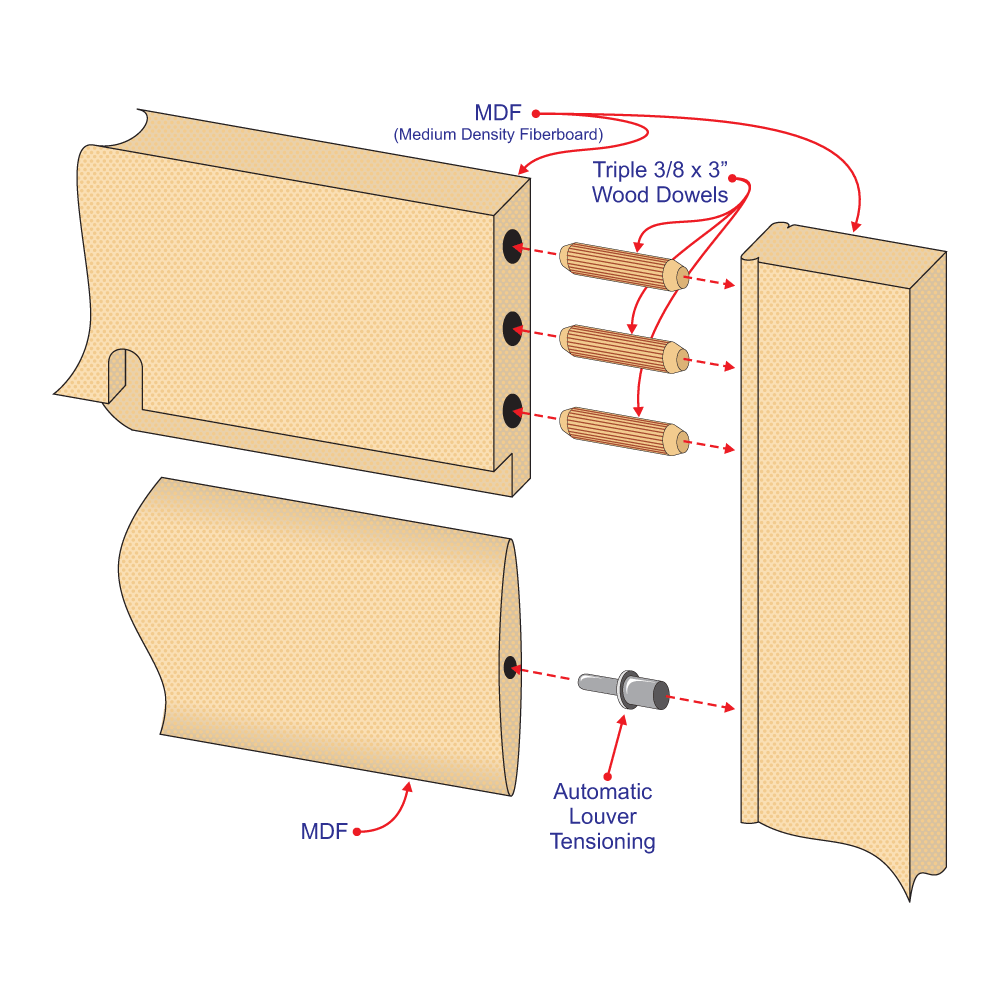 MDF (Medium Density Fiber) shutters are also called “hybrid” and “composite” along with some other trade names. All these window coverings are made from MDF as the base material. MDF is basically sawdust mixed with glue and formed in the shape required. The coatings range from a vinyl wrap to a painted finish. Advantages are cost to manufacture and cost to the consumer. They look very much like more expensive wood shutters. They are stable and resist warping. Disadvantages are their inherent inability to stand up to water, they have the habit of swelling and the finish peeling when exposed to too much moisture. The material is brittle and can easily break under impact. The material will eventually sag under stress over a long period of time. They cannot be successfully stained. This material is rapidly becoming a major part of the window covering market due to its cost and appearance.
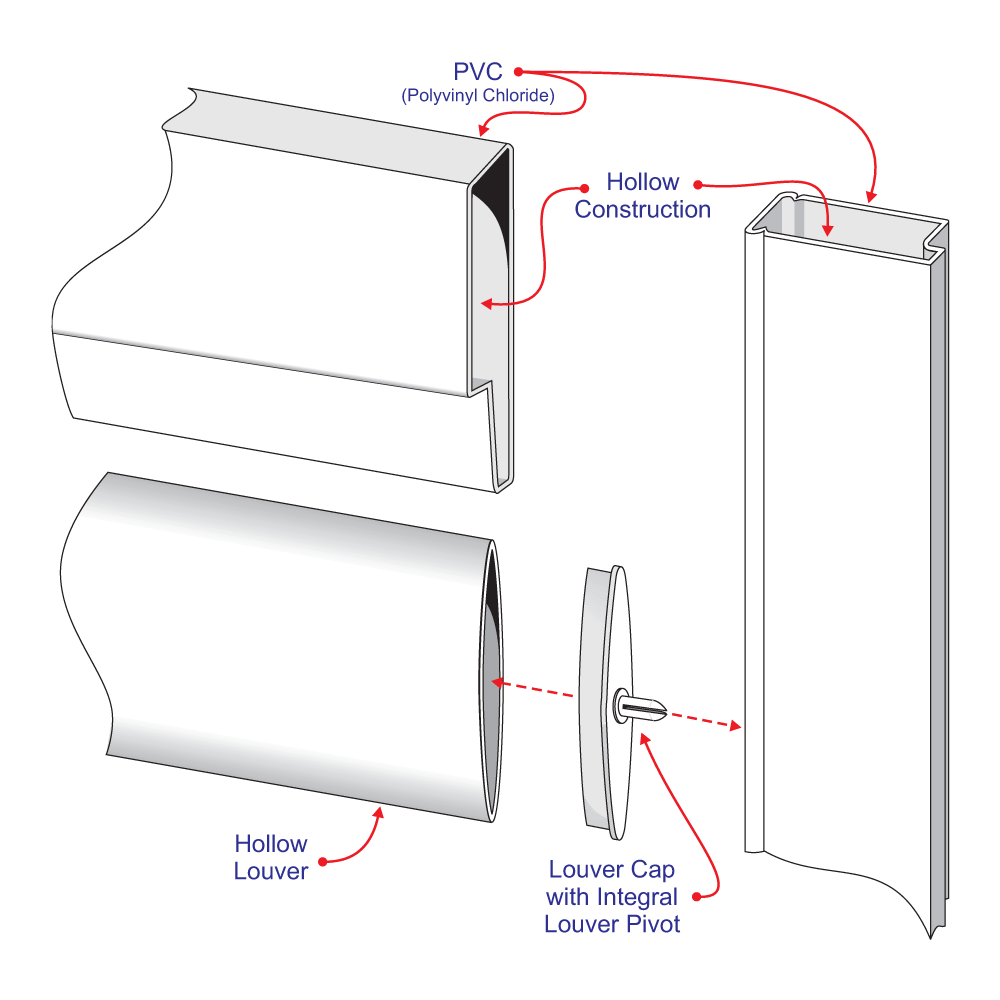 PVC or (Poly Vinyl Chloride), is an extruded hollow vinyl. The material is extruded PVC which is either a hollow extrusion or one which also has some reinforcing webbing on the interior. This has been around about 12 years. It can be identified by its appearance; it is not finished and the edges of the blades have caps to seal them. The connectors to the tilt rods are plastic “t” connectors which tend to break. Its advantages are its low cost. Disadvantages are the “plastic” appearance, a tendency to yellow when exposed the strong sunlight, some brittleness after exposure to UV, and a limited choice of colors. After aging, the material can be hard to clean. They cannot be stained. Please note that the fumes when it burns are very toxic and the material will out gas (release chemicals) for the life of the product.
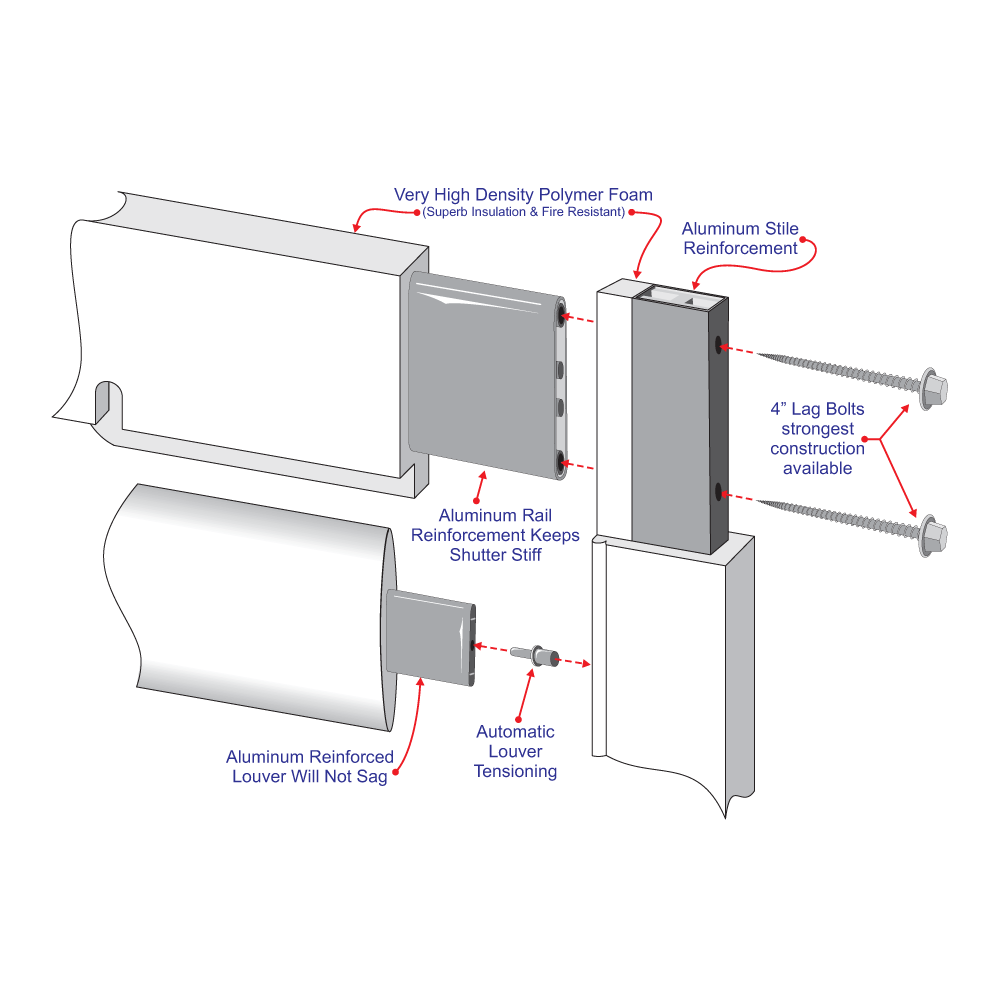 Foamed Synthetics. Sold under various trade marks such as Thermalite, Poly Therm R, Duracore™ etc. Its advantages include its more reasonable purchase price than wood shutters, depending upon the seller. They are water resistant, fire resistant, non toxic and provide excellent insulation. Some designs ( Poly Therm R and Duracore™) come with a reinforcing aluminum center and thus have a much more rigid construction, which prevents sagging and bowing.. They are available in shapes and many colors. This material is most like wood in appearance. This is probably the best choice for a synthetic shutter. Disadvantages, they are heavier than wood and not as stiff so the design can be limited as to its capabilities, unless they have are aluminum-reinforced. They cannot be stained. Most companies will not build these taller than 80 to 96 inches.
 Engineered Wood. Sold by several companies under different trade names such as (PHD) (Finger jointed etc.) Finger jointed wood can be of one specie or several species glued together. Advantages, this material is very stiff for its weight making it ideal for tall or wide shutters. It can be used wherever solid lumber was used previously. The cost should be less since it is made from lower quality grades of material. It can be made with many shapes and colors. Disadvantages, it cannot be stained since the joint lines will show. If not very carefully manufactured the joint lines can in time show through the painted finishes. When dissimilar materials are used to manufacture it there is a possibility of uneven expansion and contraction that can lead to joint failure.
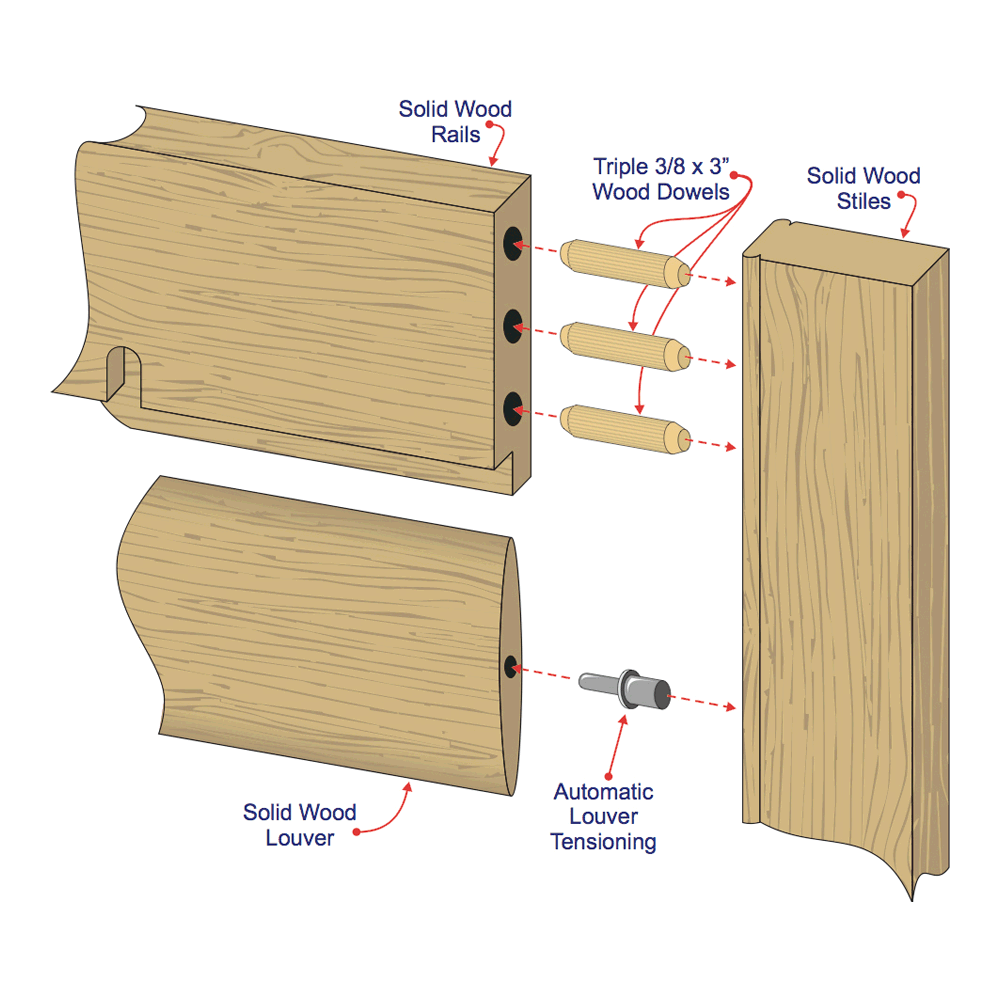 Basswood. This is the most common of shutter materials. It has taken over as the material of choice from pine and poplar. Advantages include lightness, stability (the resistance to warping) and flexibility of design. They can be painted or stained, smooth or sandblasted in almost any design required. Disadvantages include being limited to lengths of 12 feet or under and the fact that it requires more preparation than other woods to achieve a quality finish, which adds to the cost. The wood is very homogenous in texture and grain, leading to stains that do not have much figure or beauty to them. Basswood is not water resistant and is not recommended for high moisture situations.
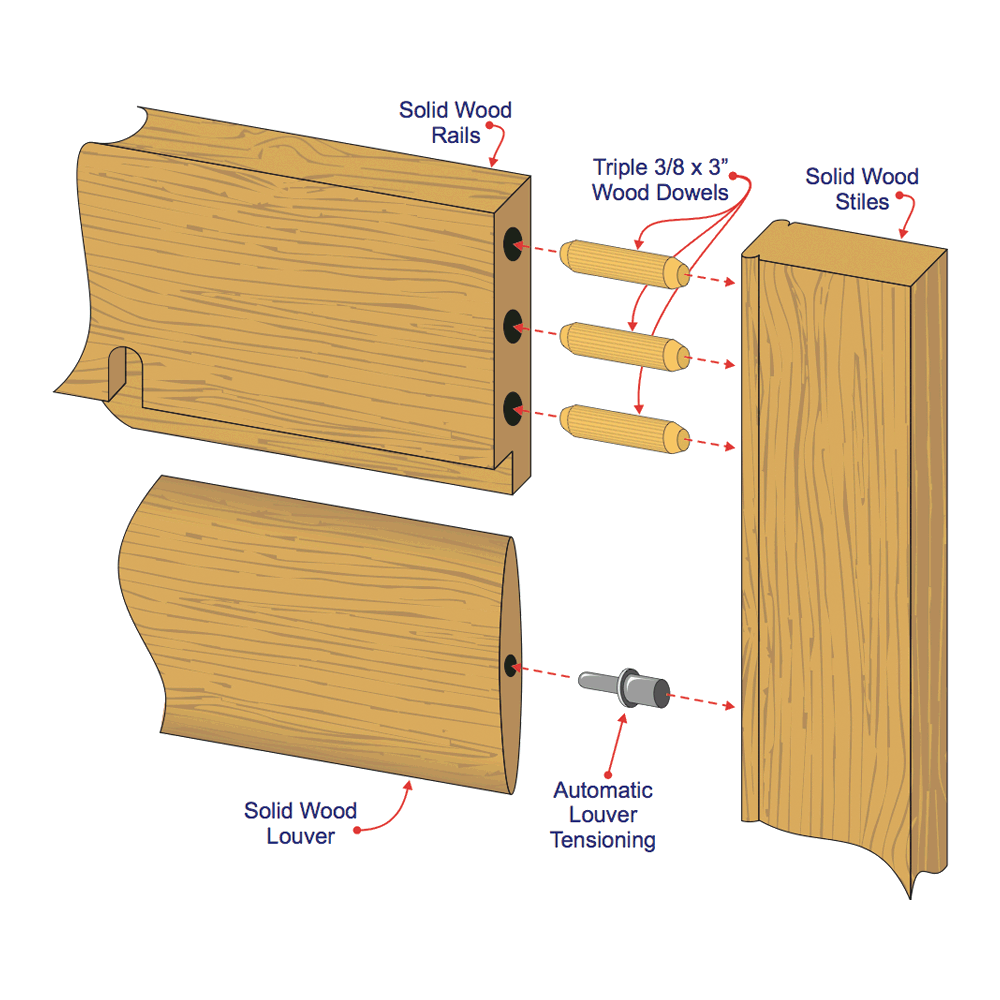 Alder. This may be the “Cadillac” of wood used in the best shutter manufacture. It is a hardwood typically from the Northwestern part of the United States. Advantages include: Hardness of the material, it is greater than most, making it harder to damage accidentally. Almost any design can be accommodated. In appearance it has the grain of cherry wood and is often mistaken for cherry when used to manufacture furniture. It has beautiful grain figuring giving a stain appearance rarely seen in shutter manufacturing. It is stable and takes a painted finish very well. Disadvantages are: limitation of 10 feet to shutter length and cost is higher than most materials do to the high wastage incurred during the manufacturing process. It is not resistant to moisture and not recommended for high moisture situations.
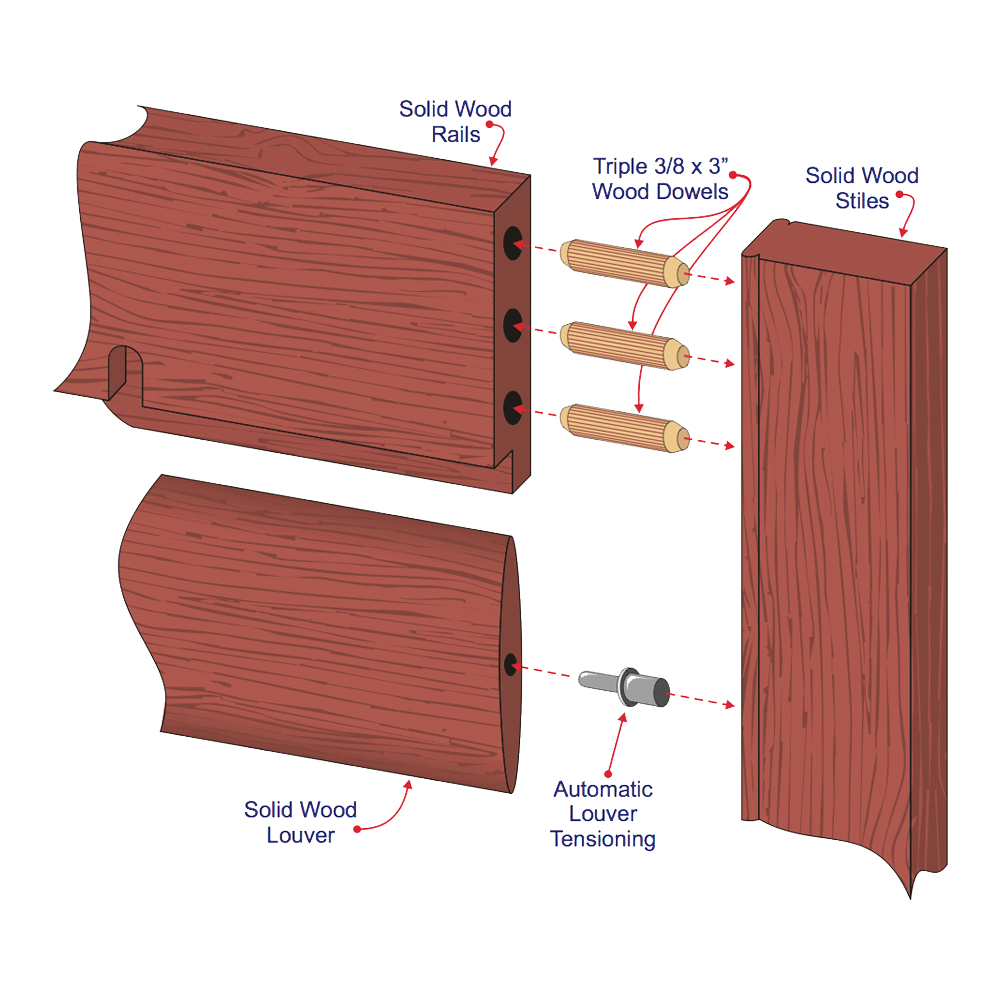 Incense Cedar. Another very high quality material for shutters. Cedar comes from northern California and further up the west coast it is a very large and tall tree that produces extremely stable lumber giving the shutter the best resistance to warping, cupping, or bowing in the shutter industry. Cedar also finishes remarkably well and is capable of a very fine finish either in a stain or paint. The grain is reminiscent of fir or pine but it start out with a rosier tint. It can make very large and wide panels. Larger and wider than any other wood in current shutter manufacturing use. Interestingly Incense Cedar is very rot and insect resistant. Cedar is not inexpensive and requires a certain amount of care in the manufacturing process. Accordingly it is not found in cheap or cheaply made shutter panels. It is not resistant to high moisture environments and is not recommended for high moisture as a result.
Laminated Shutters. These window coverings are manufactured using thin slats of lumber that are glued together to form the shapes required. Known by several name brands “New Style” and “Phoenix Wood” are a few. The best shutters when properly made should be very stable and can look as good as solid wood shutters. The finishes can be wrapped, painted, or stained. The material can be used wherever solid wood shutters are acceptable. Due to the inexpensive materials used the prices can be lower. The disadvantages include the inability to stand up to high moisture and subsequent possible delamination of the material. This material is not recommended in high moisture environments.
How Can I Tell the Difference Between Different Shutter Products?
Let’s face it: every shutter salesperson you’ve welcomed into your home has told you that their product is the best on the market, right? As homeowners new to the world of shutters, how do we make sure we’re getting the best shutter product and the best deal?
I am going to tell you some easy ways to separate the wheat from the chaff when you inspect these products.
First, we need to separate faux wood shutters from wood shutters.
Originally, all shutters were made of wood. For wood shutters, the first thing to look at is the finish. Because of their quality finish, the best wood shutters should look thick and lustrous and feel like smooth plastic. If they have been painted rather than stained, there should be no grain raising or telegraphing (the paint following the grain pattern) in the product at all. Finishes that look thin usually are. Wood shutters that have been stained a natural color should have a generous clear top coat and look deep and rich. They should also be smooth to the touch. When you hold the panel up to light, do any gaps allow light to pass through in the joint area? There should be none. Grab a louver (blade) and try to move it from side to side. Is it sloppy or tight? Quality wood shutters have no more than 1/32” play. Then close the louvers completely. Well-designed shutters will only close upward. The louvers will close tightly with minimum light leakage through the blade area. Where the louver meets the stiles (the vertical part of the frame), there should be no more than a 1/32” gap. Open the louver fully downward and look where the blade touches the top rail (frame) of the shutter. This should be touching all the way across or at most 1/32” gap anywhere. This will tell you if the louvers have been drilled in the correct position. When you see panels with one or more of these faults, remember that these are merely the visible part of the shutter! Ask yourself what the manufacturer has done that is not visible to the homeowner, such as the type of joinery, dowels, etc. As a savvy homeowner, you know that most home improvement salespeople simply parrot that their product is the best. Only veteran shutter designers work consultatively with you from years of experience and deep product knowledge.
Also, remember that the shutter panels you will see during a home consultation are well-used samples and are subject to lots of abuse in the field—forgive things like dents, gouges, etc. Reputable manufacturers honor their finished product and cover them via their warranty.
When it comes to synthetic shutters, you will often find yourself barraged with confusing terms like “hybrid, new style, composite, etc.” You can safely ignore such verbiage since these are all variations on faux wood shutters. The finishes on all synthetic shutters should be smooth and lustrous, with no orange peel. These shutters should close better than wood shutters because they are man-made. Gaps, louver play, and all other construction details on the panel may be evaluated just like wood shutters. Finally, synthetic shutters come in three distinct manufacturing materials: PVC, MDF, and Foamed Synthetics. How can you make the right choice between them? It’s easy. Just go onto our website and click on the link to A Consumer’s Guide to Shutters. This guide will reveal even more industry “secrets” and provide you with the insider knowledge you need to make the right choice for your home.
I look forward personally to hearing your questions or comments on this topic!
Irv Schnell